







Common container insert options analysed
A guide to selecting the correct reusable packaging inserts
Inefficient handling of parts can play a significant role in the success (or otherwise) of your manufacturing.
It can waste time, lead to product damage, slow down production operatives in finding the parts they need or prevent them from quickly seeing when they are going to run out of something.
If your business is experiencing any of these difficulties, a range of returnable packaging inserts and dunnage options can prove invaluable.
But which should you choose? Which insert type is most suitable for your business, industry, products, or application?
In this guide, we’ll analyse the most commonly used options:
- Correx® dividers and inserts
- Foam dunnage
- Vacuum-formed inserts trays
- Custom inserts
- Single-trip corrugated
Contents
Returnable packaging inserts
Selecting inserts or dividers for your returnable packaging or handling containers
The number of different dunnage options can initially seem quite daunting. How do you select the correct returnable packaging inserts for your business or specific application?
Several factors can influence which option is most likely to succeed.
Considerations can include, but are not limited to, the volumes, sizes, shapes, and values of the items you are transporting or handling, the environment in which the inserts are used, and, of course, your budget.
Why use tote inserts?
Before analysing which insert options would be best for your specific application, it’s essential that you consider why you would use them.
Arguably, the key benefit of using packaging or container inserts of any type is to minimise any movement within the outer container during transit or handling. This movement is the most common cause of damage to parts, components, and products, either during movement within your production facility or along the wider supply chain.

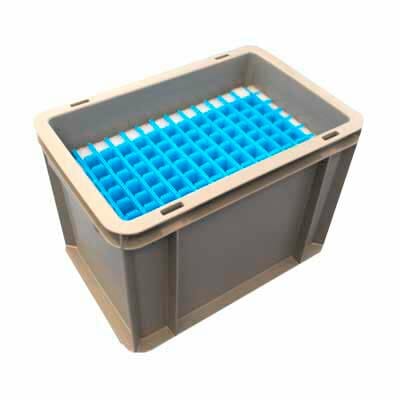
All available options, including foam dunnage, Correx® divisions, bubble-board inserts, and vacuum-formed plastic insert trays, can prevent this movement (and the resulting damage) by housing each item in its own recess or “cell”.
Doing this has other benefits too.
For starters, it makes loading and unloading the parts and components easier. It makes moving multiple parts much more efficient. It allows for quicker visual stock checks “at a glance” and prevents totes or outer containers from being overloaded (aiding health and safety).
Ultimately, as well as preventing damage to parts during handling or transit (and the associated costs), the right dunnage can significantly improve your productivity too.
Correx® dividers
Best all-rounder insert option
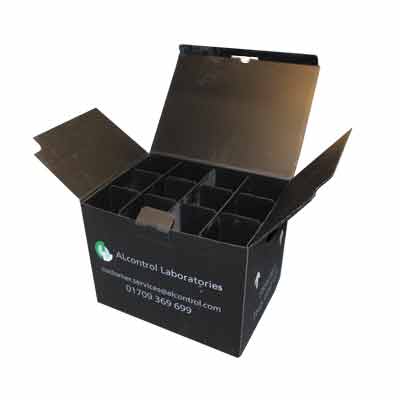
Correx® dividers are an excellent all-round solution for virtually any application.
Tooling and unit costs are relatively low compared with other options, though you may incur additional costs due to longer assembly times (compared with some of the other insert options).
Plastic container dividers are available in various configurations, different colours and even ESD-safe (e.g., anti-static) versions.

However, they only create simple cells, which can limit protection for higher-value items. Besides this, they are effective only in single layers (as they do not retain their shape or hold their contents once removed from their outer container). This latter point can be rectified somewhat by using layer pads, however.
All this means that for most handling or returnable transit packaging applications, you should consider using Correx® division sets.
Vacuum-formed trays
Best for protection and mid- to high-volume
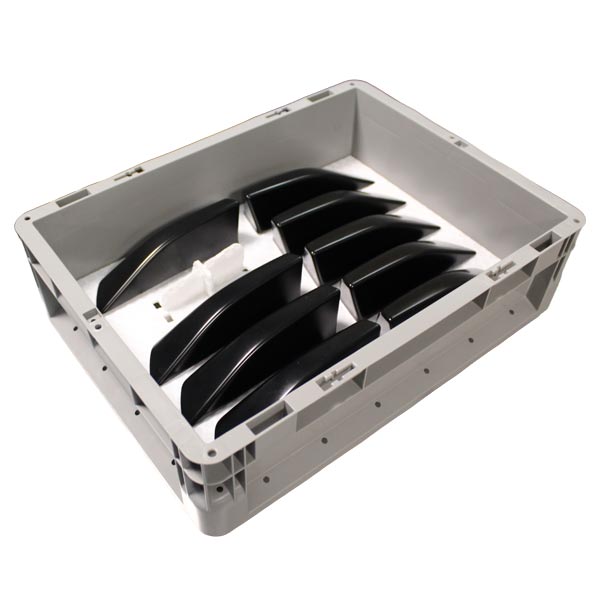
Although commonly used as standalone plastic trays, vacuum-formed trays are arguably the best container insert option when both usability and protection are required.
Being tailored to the shape of the products or components you are handling or transporting, they can almost completely eliminate movement.
This protection offered by vacuum-formed trays can minimise surface scuffs, scratches, and mishandling.

They are also great for usability. As a single piece of material, vacuum-formed dunnage can be easily stacked and layered with a single outer tote. They are also a popular choice for use as kitting trays.
However, they are only suitable for mid- to high-volume requirements due to the high tooling and setup costs.
Correx® inserts
Best compromise between cost and performance (for lower volumes)
Custom Correx® inserts are effectively a compromise between Correx® dividers and vacuum-formed trays.
Formed from a single piece of material with shapes specific to the parts or components cut out, they offer increased protection against movement while maintaining lower unit costs.
Saying that, they are more expensive (and less versatile) than plastic division sets, whilst not offering the same level of protection as vacuum-formed options. They are also not as cost-competitive at high volumes.

Foam dividers and dunnage
Best for low volumes
A key benefit of foam dividers and similar dunnage is that they incur no tooling charge (although there is usually a small machine setup cost, which is insignificant compared with tooling).
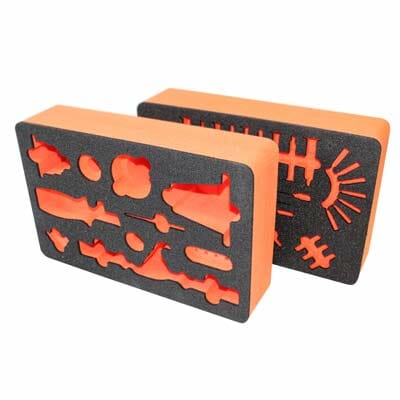
Foam dunnage also provides excellent levels of protection, offering cushioning protection against impact or mishandling.
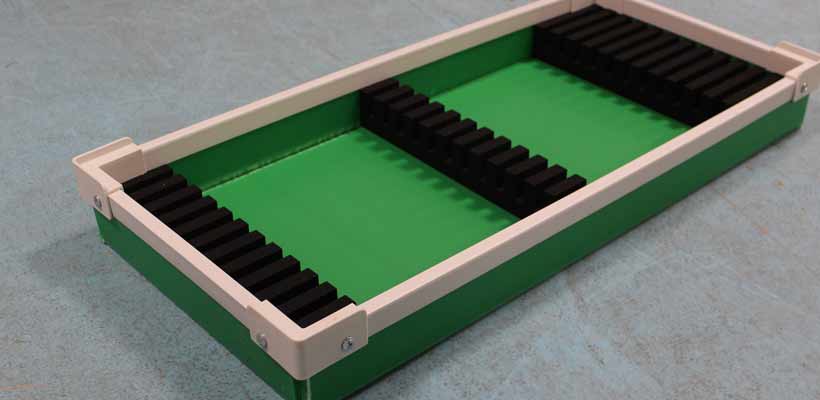
However, the individual unit costs are high (suitable only for lower volumes), and they can “shed” material (creating dust) over prolonged, repeated use.
Whilst ESD-safe foam grades are available, increased potential for surface contact can often increase the risk of shorting and static damage.
Engineered foam inserts
Highest levels of protection
If you have very delicate (or expensive) parts or components, engineered foam inserts or trays provide the highest levels of protection.
Foam can achieve this by engineering precise levels of cushioning protection into the insert using advanced software, drop-test data, and various foam grades.
As with other forms of foam dunnage, the material can be susceptible to some fibre shedding, making it unsuitable for some medical or clean-room applications.
They are also relatively expensive (certainly compared with other dunnage options), though eliminating damage to expensive parts or componentry often offsets this.

Corrugated cardboard dividers
Lowest cost option
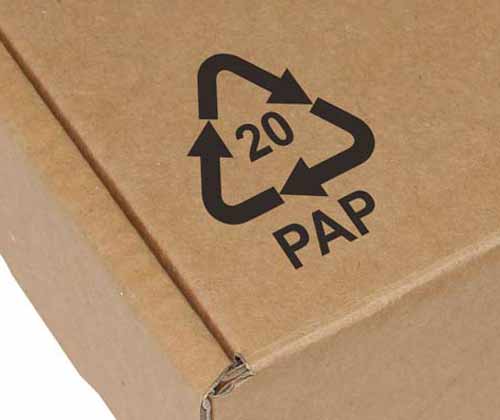
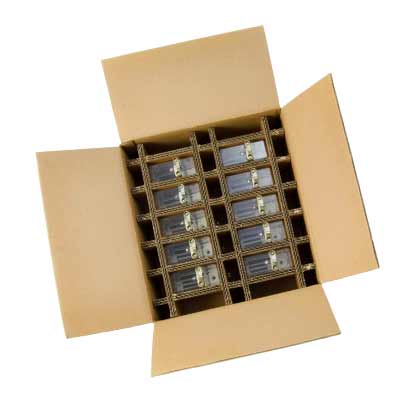
Corrugated cardboard dividers (and other paper-based inserts) are the lowest-cost option for dunnage.
As with Correx® dividers, cardboard inserts can be supplied in many configurations and help with organisation and damage prevention in transit.

Due to the nature of corrugated cardboard (which is less hardwearing than plastic), it is less reusable and is generally used only for single-trip applications.
They can also shed particles (similar to foam) and are not moisture-resistant. However, they can benefit from various coatings to add water resistance, VCI corrosion inhibitors, and anti-static properties.
Summary
Sourcing your dunnage options and returnable packaging inserts
Even armed with the knowledge in this guide, choosing the correct container inserts for your business can still be a big decision, but this is where GWP can help.
With over 30 years of experience in single-trip packaging and returnable transit containers, GWP can supply the full range of dunnage and insert options for your boxes or totes. GWP are also coming to the UK’s largest Correx® and foam converters and provides extensive corrugated cardboard manufacturing and design facilities.
What this also means, aside from being able to source your entire packaging requirements from a single supplier, is that you can benefit from genuinely impartial advice on the best insert or dunnage option for your specific application and industry.
If you would like more specific advice, you can speak to a member of our GWP team of packaging experts.
Share this article
Further reading

About the author

Emily has been involved in the returnable packaging industry for over a decade, joining GWP in 2014. She has excellent knowledge of both Correx and ESD packaging.
Products in this guide



Get in touch
For full details on how GWP treats your data, please view this Privacy Policy. Your info is not shared with any third party.
Related guides
Containers with dividers and other dunnage options for totes
The six tell-tale signs you need protective inserts
Enhancing your protective cases with foam inserts
What is Correx®? Everything you could need to know
Returnable packaging containers: options and applications
9 options to enhance supply chain totes and line-side containers
17 reasons to switch to returnable transit packaging