









Introduction
Finding the perfect fit for your products
Whether you’re shipping delicate electronics, automotive parts, medical equipment, or consumer goods, the packaging inserts you choose make a significant difference.
About 81% of businesses report that damaged deliveries are an issue, with nearly 32% saying they negatively impact their brand’s reputation. This highlights the importance of choosing packaging that meets all your product requirements.
Packaging inserts are a vital part of how your products are handled, stored, and presented. They help reduce movement, lower the risk of damage during transit, and can even make it faster and easier for staff to pick, pack, and ship items efficiently.
There’s a wide range of options available, each suited to different needs and product types. Some inserts provide rigid, reusable dividers for repeated use, others focus on cushioning and shock absorption, and some are custom-shaped to hold products precisely. Understanding your options will help you make the best decisions for your business and products.
In this guide, we’ll explore three of the most commonly used insert types: Correx® inserts, foam inserts, and vacuum-formed trays. You’ll learn what each material is made from, the situations in which it performs best, and the advantages and limitations to consider.
Contents
Correx® inserts
Durable and cost-effective
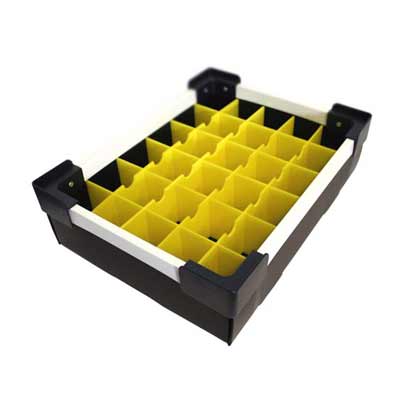
Correx® inserts are made from extruded, fluted polypropylene sheets, forming a lightweight yet strong divider system. These inserts are excellent for businesses seeking reusable, low-cost, water-resistant solutions.
You’ll commonly find Correx® packaging used across automotive, manufacturing, pharmaceutical, eCommerce fulfilment, and warehouse environments. It is widely recognised as a more durable alternative to corrugated cardboard, lighter than wood, and resistant to water, chemicals, oils, and grease.
Correx® inserts appear in several different formats:
- Correx® dividers create compartments within tote boxes or returnable transit packaging. If you ship multiple parts in one container, divider sets minimise movement and prevent components from knocking into each other.
- Layer pads separate stacked products inside totes or on pallets. Compared to cardboard equivalents, Correx® layer pads can last 50+ cycles, making them ideal for returnable systems.
- Custom die-cut dunnage allows recesses or shaped cells to be cut into Correx® to better match specific parts. This provides a more tailored level of protection while maintaining rigidity.

Correx® is also used to manufacture picking bins, shelf bins, trays, totes, and even full outer packaging solutions. Inserts often integrate seamlessly into these systems.
There are many benefits to Correx® inserts, including:
- Lightweight but strong.
- Water and chemical resistant.
- Easy to clean and hygienic.
- Cost-effective compared to moulded plastics.
- Suitable for both low and high production volumes.
- Available in standard or bespoke sizes.
- Improve packing speed.
- Enable easier stock checking.
- It can fold flat to reduce return transport space.
- Effective in line-side handling and multi-use returnable systems.
However, Correx does not provide cushioning in the same way foam does. While it absorbs minor shocks due to its fluted structure, it is primarily a rigid separator. It can also be cut or damaged by sharp edges or excessive force.
If your products require soft impact protection rather than structured organisation, another solution may be better suited.
Foam inserts
High-performance cushioning
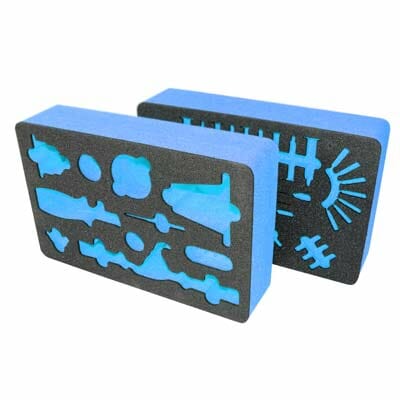
If your priority is shock absorption, vibration control, and impact protection, foam inserts offer a different level of performance.
Foam conversion involves transforming raw foam sheets into precision-cut inserts using CNC routing, die cutting, waterjet cutting, or laser engraving. This allows you to create inserts that follow the exact contours of your product.
Foam inserts are widely used in protective cases, tool control systems, electronics packaging, aerospace components, medical equipment transport, and high-value consumer goods.
Foam inserts appear in several different formats and serve different purposes:
- Plastazote® foam is a cross-linked, closed-cell polyethylene foam often used for case inserts. It offers durability, water resistance, and long-term performance. It is ideal for aluminium cases, waterproof cases, and custom flight cases.
- Stratocell® foam is a lightweight, cost-effective closed-cell foam typically used for transit packaging, including foam end caps and box linings. It performs well in high-volume eCommerce environments.
- Recycled foam options such as Stratocell® R, Ethafoam® HRC, and Ecozote® are also available for businesses seeking to reduce their environmental impact.

There are many benefits to choosing foam inserts for your packaging solutions, including:
- Excellent shock and vibration protection.
- Custom-shaped recesses for a perfect fit.
- Surface protection against scratches and marks.
- Closed-cell structures that resist water absorption.
- Branding options through colour choices and laser engraving.
With the right density and design, foam inserts can significantly reduce returns, protect your brand’s reputation, and prevent any delays that are caused by damaged equipment.
However, foam can shed particles over time, particularly in high-friction environments, making it unsuitable for clean rooms or contamination-sensitive environments.
At higher volumes, foam solutions can be more expensive per unit than vacuum-formed alternatives and may require more space than rigid, nestable inserts.
Despite foam excelling in cushioning, it is not always the most space-efficient or contamination-controlled solution.
Vacuum-formed inserts
Precision-moulded and clean handling solutions
Vacuum-formed inserts are created by heating a thermoplastic sheet and using vacuum pressure to form it over a mould. This produces a rigid tray with shaped cavities that perfectly hold your products.
If you require clean, repeatable, and space-efficient packaging at high volumes, vacuum forming might be more ideal for you.
Common materials include High-Impact Polystyrene (HIPS), PETG, and ABS. HIPS is a widely used material due to its cost-effectiveness and recyclability.
Vacuum-formed trays are frequently used in:
- Automotive manufacturing
- Electronics assembly
- Medical and clean-room environments
- Food production
- Aerospace applications
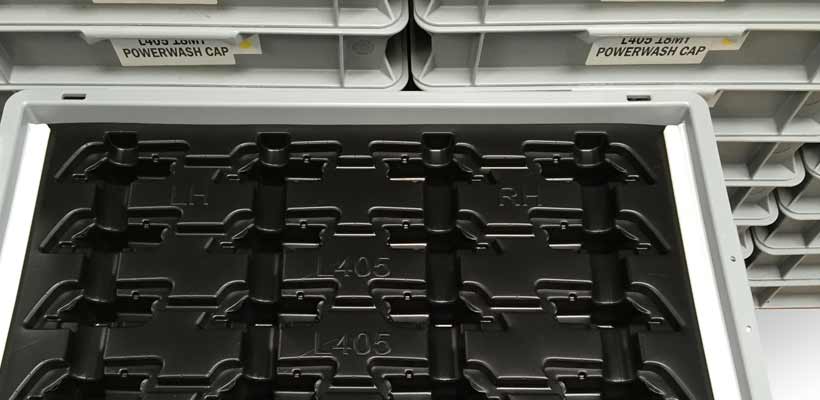
Because the material does not shed particles, it reduces the risk of contamination and Foreign Object Damage (FOD).
There are many benefits to choosing vacuum-formed trays for your packaging solutions, including:
- Precise cavities tailored to your components.
- Nesting designs that save space when empty.
- Rigid structure for consistent positioning.
- Easy cleaning and moisture resistance.
- Moulded-in part numbers or branding.
Although tooling costs are initially higher, unit costs become very competitive at mid- to high-volume production levels. The process also allows rapid production cycles once tooling is complete.
Vacuum-formed trays, however, do not provide cushioning. They secure items firmly but do not absorb shock as well as foam.
Initial tooling costs are higher than for Correx® or basic foam designs, making them less suitable for very small production runs.
Summary
Choosing the right insert for your application
When choosing between Correx® inserts, foam inserts, and vacuum-formed inserts, the right packaging solution for you depends entirely on your objectives.
If you require reusable, rigid organisation within totes or returnable systems, Correx® inserts provide durability and cost efficiency.
If your products are fragile, expensive, or impact-sensitive, foam inserts provide superior cushioning and tailored protection.
If you operate in high-volume environments where precision, cleanliness, and space efficiency are paramount, vacuum-formed inserts deliver consistency and long-term cost savings.
The right insert can reduce damage, improve packing efficiency, protect your brand’s reputation, and lower overall lifecycle costs.
If you’re still unsure which solution best fits your application, contact our team of packaging experts, who will be happy to help you save time and money.
Share this article
Further reading

About the author

Emily has been involved in the returnable packaging industry for over a decade, joining GWP in 2014. She has excellent knowledge of both Correx and ESD packaging.
Products in this guide


Get in touch
For full details on how GWP treats your data, please view this Privacy Policy. Your info is not shared with any third party.
Related guides
7 tips for shipping high value equipment, tools, and parts
Foam conversion – what is it, and how it benefits your business
9 often overlooked advantages of hybrid packaging
7 important advantages of automotive returnable packaging
What is Foreign Object Damage, and how can it be prevented?
What is Correx®? Everything you could need to know
5 dunnage options and returnable packaging inserts
Is using foam packaging bad for the environment?
How to set up and manage a reusable packaging system
17 reasons to switch to returnable packaging
5 ways to reduce storage needed for your packaging
Plastazote® foam – what is it and should you be using it?
Containers with dividers and other dunnage options for totes
9 options to enhance supply chain totes and line-side containers
Advanced tactics to improve order picking and packing