








Defence standard packaging
Requirements for supplying goods to the UK MOD
If your company supplies products to the UK Ministry of Defence or other businesses working with the military, you must understand what Def Stan 81-41 packaging is.
Def Stan is shorthand for Defence Standard. These detail a series of material standardisations developed by the UK Ministry of Defence (MOD). The standards support improved interoperability and more effective acquisition. Def Stan 81-41 are the standards relating specifically to packaging.
This guide provides a detailed overview of Def Stan 81-41, the criteria your business must meet when supplying packaged goods to the UK military, processes, testing, markings, and more.
Contents
Introduction
A brief overview of Def Stan packaging
In simple terms, Defence Standard 81-41 is the criterion the UK Ministry of Defence (MOD) specifies for military packaging. The aims are to protect goods from deterioration and physical or mechanical damage and ensure consistency and interoperability across the MOD’s operations. The standards also allow for more effective acquisition across the organisation.
Def Stan 81-41, divided into six parts, primarily concentrates on environmental conditions to ensure the preservation of items during storage, general handling, and distribution, or transit via rail, road, sea, and air.
What are the six parts of Def Stan 81-41?
The six components of Defence Standard 81-41 are:
- Part 1: Defence packaging requirements
- Part 2: Military packaging design
- Part 3: Environmental testing
- Part 4: Service Packaging Instruction Sheet (SPIS)
- Part 5: Production processes
- Part 6: Package markings

Part 1: Defence packaging requirements
What are the common military packing levels for preservation?
It is important to note that, in accordance with Def Stan 81-41, packaging can be one of three different levels:
- J: For items which may be stored anywhere in the world, within any climatic condition, for up to two years.
- N: For items which could also be stored anywhere in the world, in non-climatic conditions (clean and dry), for up to five years.
- P: Similar to commercial packaging, and can be designated to items that need to be stored for up to five years, but only in normal storage conditions.
Determining which level your packaging should meet helps you select suitable design and material(s).
Part 2: Military packaging design
Design requirements for Def Stan 81-41
The UK military packaging design requirements correspond to the military packaging levels required for your item.
Your packaging provider typically requires the following:
- A NATO Stock Number (NSN), a 13-digit unique identification code assigned to each item that the MOD utilises.
- The name and description of the item to be packaged.
- The specific department within the MOD (Army, Navy, or RAF) overseeing the item
- The manufacturer’s part number.
- Dimensions and weight of the items.
- Primary Package Quantity (PPQ).
- Information on whether the MOD will store the item and the anticipated duration.
- Fragility factor of the items.
- Resistance level of the items to G-force.
- The centre of gravity for the items is essential for safe lifting and loading during transportation.
Knowing the specifications for your item and the type of packaging allows you to predict how the packaging will respond to testing and environmental conditions.

Part 3: Environmental testing
Environmental package testing programme
Def Stan 81-41: Part 3 assesses the performance of a package or enclosure under varying environmental conditions. It assesses explicitly physical and ecological hazards expected in a military package lifecycle.
Environmental package testing evaluates a package’s overall ability to offer the necessary protection for an enclosure material during storage and transportation.
By subjecting the package to climatic and physical testing conditions, packaging suppliers can obtain sufficient data for fair performance assessments.
Specific procedures in this standard may need to align with the respective test methods in Defence Standard 00-035 Part 3.
Additionally, electromagnetic compatibility testing may occasionally be required to evaluate suitability against additional criteria. Def Stan 81-41 does not specify these tests, however.
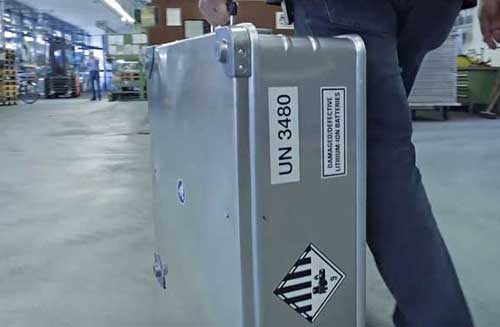
It’s also important to note that Def Stan 81-41 does not cover certification testing for packaging designed for the supply or carriage of dangerous goods, for example, products that include lithium-ion batteries.
Before testing
Before testing begins, your provider must identify the package’s faces, edges, and corners.
For rectangular packages:
- Edges are identified by the numbers of the two adjacent faces.
- The number of three adjacent faces identifies corners.
- The manufacturer’s joint is located at the near end of face five at edge 5/2.
For cylindrical packages:
- Quarter points around the top edge are designated as points one, three, five, and seven.
- Those around the bottom edge are edges two, four, six, and eight.
- Imaginary lines joining the top and bottom quarter points of the edges should be parallel.
Conditioning
Initially, a package undergoes conditioning for a minimum of 16 hours or until temperature stabilisation (unless otherwise stated).
The temperature and relative humidity conditioning should adhere to the standards outlined in ISO 2233 – a standard specifically for conditioning transport packages and unit loads.
Nevertheless, maintaining analogous relative humidity tolerances may not always necessitate the same temperature tolerance.
Types of test procedures
Def Stan 81-41 testing requirements
After identifying the packaging’s faces and conditioning, the packaging must then undergo another series of testing.
Temperature
There are four tests focused on temperature and its effect on packaging and its contents:
- Test B: Known as the damp heat test in Def Stan 81-41, it gauges the climatic resilience of a package and assesses its ability to withstand tropical conditions. The testing unit undergoes either 4, 21, or 28 cycles of damp heat, each lasting 24 hours.
- Test C: Known as the dry heat test, it examines how drying affects the package’s protective characteristics. Adverse effects, such as timber shrinkage and fastening loosening, are evaluated. The test is conducted over 48 hours, maintaining a temperature of +55°C.
- Test G: Designated as the low-temperature test, it aims to assess the condition of a package and its contents under low-temperature conditions. The tester positions the package within an appropriate test chamber under standard laboratory conditions. Subsequently, the chamber temperature is sustained for 16 hours after the package reaches the specified test temperature.
- Test N: The dry heat exposure test conditions a package to evaluate its physical protective attributes during movement and handling in hot, dry climatic conditions. The test involves 4 or 10 cycles.

Drop testing
Four drop tests ascertain if the packaging can withstand varying impacts:
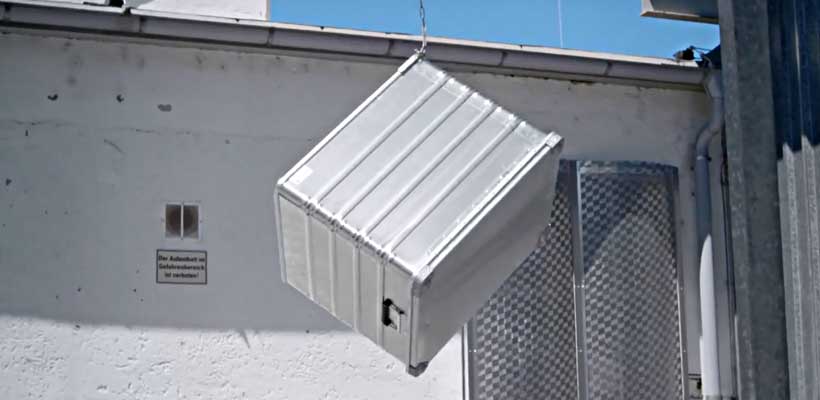
- Test D: The horizontal impact test illustrates a package’s capability to endure horizontal impacts, specifically stimulating forces from crane lifting, rail shunting, and other abrupt movements. Def Stan 81-41 mandates impact testing when the impact occurs on a face or edge, requiring the package to strike the impact surface at a velocity of 2.5 m/s.
- Test E: The vertical impact test examines the package’s integrity when exposed to vertical impacts through dropping. This type of impact testing can function as a standalone evaluation or as part of a series of tests.
The series of vertical impact tests is strategically designed to gauge the package’s resilience in a distribution system that encompasses vertical impact hazards.
- Test V: Rotational corner drop test. This type of testing assesses the resilience of a sizable shipping container when subjected to impacts at its corners.
- Test W: Rotational edge drop test, comparable to corner drop testing, evaluates the impact on a package and its contents when dropped from an edge.
Static load test
- Test H: A static load test exposing packages and packaging systems to compressive loads. The method involves applying loads to the lower containers within a stack of identical containers. This test evaluates the container’s protective capability under compression, considering factors such as buckling, crushing, or partial collapse deemed unacceptable.
Topple test
- Test Q: The topple test primarily assesses potential damage from bending or shock. Not only does this help protect the products within the packaging, but, depending on the packaging’s weight or shape, this test can also help outline and prevent injury during handling.
Rolling test
- Test R: The rolling test assesses the structural integrity of a package during handling and potential tipping on either a face or edge, which is why the tester records the faces at the beginning of the testing phase. Rough handling and package tipping are typically attributed to inadequate equipment or impractical lifting facilities.
Vibration test
- Test K: The vibration test in Def Stan 81-41: Part 3 tests a package’s capacity to withstand vibrations across a frequency range that includes transportation frequencies. It consists of the variation between road, rail, sea, and air.
Water immersion test
- Test T: The water immersion test. This test assesses a package’s resistance to water penetration from a static head of standing water. This form of testing, also referred to as ingress protection testing or IP code testing, simulates conditions such as flooding or water accumulation. The test involves exposing the unit for approximately 20 minutes.

Mechanical handling test
- Test X: A mechanical handling test assesses the package or container’s capacity to endure the rigours of mechanical handling equipment.
Test result documentation
Following the conclusion of the test procedure, the generation of a comprehensive report encompasses the following details:
- Package design reference number.
- Packaging level.
- Gross package mass.
- External package dimensions.
- Visual depiction and documentation of any damage or deviations from the specification.
- Identification of any malfunction in fittings and hardware.
- Evaluation of damage or spillage of the package contents.
Part 4: Service Packaging Instruction Sheet (SPIS)
Cleaning, preserving, and packaging military materials
The Service Packaging Instruction Sheet (SPIS) is a comprehensive manual outlining procedures for the upkeep, cleaning, and packing of military equipment and materials.
An MPAS packaging provider can request the status of an SPIS design using a DEFORM 129A. This request provides insight into whether an SPIS exists and whether a Standard Family Specification (SFS) has been applied to the item slated for packaging.
Furthermore, the DEFORM 129A serves the dual purpose of soliciting authorisation to receive a copy of the SPIS, update an existing SPIS, transition to an SFS, or create a new SPIS design.
Part 5: Production processes
Producing Def Stan 81-41 packaging
The production process is evaluated as set out in Def Stan 81-41 and is conclusive of the materials and processes required to manufacture the packaging.
The item being packaged and the environment in which the MOD will store and transport it influence the specific requirements.
Packaging manufacturers are required to stay up to date on the current version of the defence standards.

Part 6: Package markings
Labelling procedures and requirements
The labelling procedure must conform to the military packaging requirements specified in Def Stan 81-41 (Part 6).
Suppliers must use either a waterproof, transparent strip of tape with pressure-sensitive adhesive or a layer of adhesive emulsion and polyvinyl acetate to protect external paper labels. Further detailed instructions for these materials are available in the Defence Standards, specifically Def Stan 75-3 and Def Stan 80-132.
Alternative labels, such as ISPM 15, already exist for pallets, where the wood undergoes heat treatment to facilitate international shipments of goods.
Summary
Finding a Def Stan 81-41 packaging supplier
Military packaging is inherently more complex and requires greater consideration than standard packaging. However, defence standards, including Def Stan 81-41, ensure that packaging protects equipment against all eventualities, arrives intact, and remains serviceable with the appropriate documentation.
At GWP, we have more than 30 years of experience providing military packaging across the wider Macfarlane Group, and, as MPAS-certified packaging suppliers, we can also help you with free, impartial advice.
If you need help understanding Def Stan 81-41 and how it affects your packaging, please speak with one of our packaging experts.
About the author

Kalon has strong knowledge and experience of timber, heavy duty and composite packaging, and holds an MPAS certification.
Important note
Due to the sensitive and regulated nature of the topic this guide addresses (military packaging) we have taken extra steps to ensure its accuracy and reliability. You can find out more in our content policy.
All information is, to the best of our knowledge, accurate and correct at the time of publication. Please also note that, as all scenarios vary, not all information contained in this guide may apply to your specific application. There may also be specific regulations or laws, not covered within this particular guide, that apply. Please view the list of defence packaging regulations for further details.
Share this article
Further reading

Products in this guide




Get in touch
For full details on how GWP treats your data, please view this Privacy Policy. Your info is not shared with any third party.
Related guides
UK military packaging requirements – An essential guide
NATO Packaging: A complete guide for businesses supplying the defence sector
UN-approved packaging: Everything you need to know
17 reasons to switch to returnable transit packaging
IP ratings explained: Ingress protection and what it means for cases
Best equipment cases: Choosing a waterproof protector case
Enhancing your protective cases with foam inserts
Peli vs Storm cases – a detailed analysis of their differences
13 surprising advantages of aluminium cases and containers
Peli case alternatives – 11 Pelican style cases to consider