






UK vs Euro pallets
What are the standard UK pallet sizes, and how do you select the right one?
A common question you might have if you need to bulk ship many smaller products or particularly large items, is what are UK pallet sizes?
A UK standard pallet is 1200x1000mm. These dimensions refer to the pallet footprint (i.e., length x width). A full UK pallet height is a maximum of 2,200mm, a half pallet 1,200mm, and a quarter pallet 800mm.
However, even with this information, is a UK standard pallet the right option for your business (and for use in your industrial, transit, or export packaging)? In this guide, we’ll cover everything your business needs to know when choosing the best pallet for your specific application.

Contents
UK pallet sizes
Standard-size pallets used in the UK
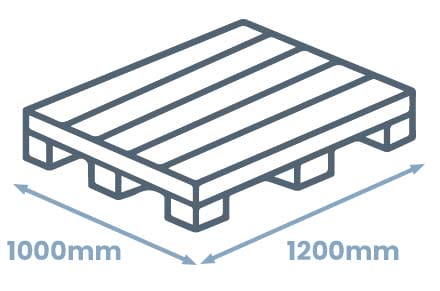
The base or footprint of a standard UK pallet is 1.2x1m (1,200 x 1,000 mm).
In imperial measurements, a standard pallet used in the UK is 3.94×3.28 feet or 47.24×39.37 inches. These dimensions allow UK standard pallets to be used seamlessly with more warehouse racking and forklifts, and are well-optimised for transportation.
Euro pallet sizes
Pallets that are used throughout Europe
Besides UK standard pallets, the other most commonly used size is a Euro pallet.
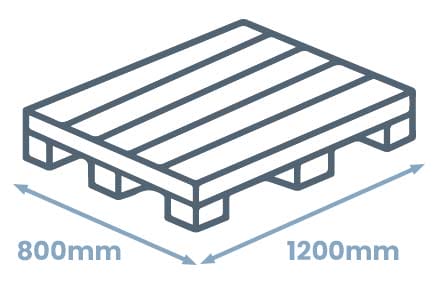
A Euro pallet measures 1.2 x 0.8 m (1,200 x 800 mm).
This footprint makes Euro pallets 20% smaller than UK standard pallets. The use of Euro pallets is commonplace across Europe, including the UK.
UK vs Euro pallet sizes
What is the difference between UK and Euro pallets?
The main difference between UK standard pallets and Euro pallets is their size. At 1,200×1,000mm, UK pallets are 20% larger than the 1,200x800mm Euro pallet.
However, both pallets are among the six accepted sizes for international export defined by the International Organisation for Standardisation (ISO).
As such, the pallet size you select for your business is primarily influenced by two factors. These are the size of the goods you are shipping (e.g., which pallet is the closest fit in terms of size) and which format your customer would prefer you deliver the items in.
Standard pallet heights
Quarter, half, and full pallet sizes
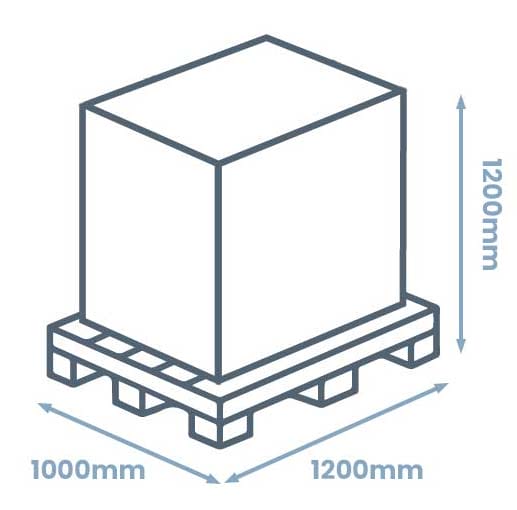
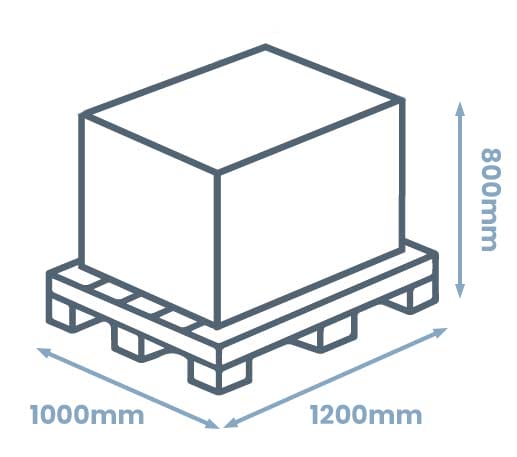
Besides the pallet’s footprints, it is common for loads to be referred to as full, half, and quarter pallets. This terminology refers to the height of the load on the pallet.
A full pallet has a maximum height of 2.2m (2,200mm), a half pallet has a height of 1.2m (1,200mm), and a quarter pallet has a height of 0.8m (800mm). These heights apply to both Euro and UK pallet sizes.
Less standard is a light pallet, which has the same height as a full UK pallet but a lower weight allowance (maximum weight of 750kg vs 1200kg for a full pallet). Some suppliers also provide micro pallets with a height of 0.6m (600mm).

Full size pallet
Half pallet
Quarter pallet
Standard pallet weights
Maximum loads for different pallet sizes
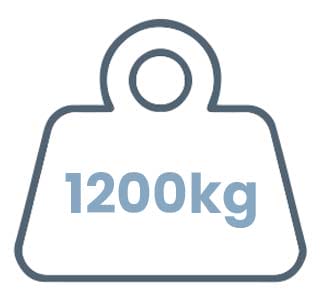
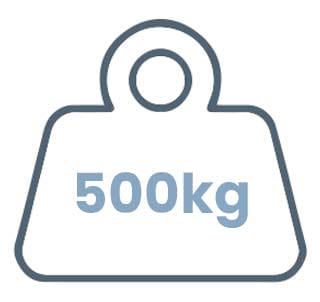
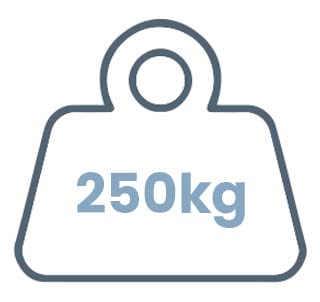
Various pallet sizes can accommodate different weights. A UK standard full pallet can have a maximum load of 1,200kg, whilst a half pallet can carry 500kg, and a quarter pallet 250kg. These weight limits apply to Euro and UK standard pallet sizes.
Full pallet weight
Half pallet weight
Quarter pallet weight
Oversized pallets
Using custom-sized pallets for shipping
There are many applications where a standard pallet size is unsuitable for a specific product. For example, businesses shipping furniture, industrial parts, aerospace components, large medical devices, or other large products will require oversized pallets.
Oversized pallets are any custom pallet larger than the UK standard size of 1,200 x 1,000 mm. Goods shipped on custom-size pallets are often referred to as “ugly freight” in the transport industry and may incur additional costs.
Other potential issues include being unable to store oversized pallets in warehousing racking, difficulty loading and unloading with forklifts, and disposal after delivery.
However, using custom-sized pallets (and bespoke pallet boxes or composite packs) is unavoidable for specific products.
Pallet packaging
Pallet sizes and impact on packaging
The size of the pallets that your business uses can significantly impact the success (or otherwise) of your packaging.
Whilst a range of standard cardboard pallet boxes is available, optimising your pallet loads can sometimes be challenging. While there are processes you can follow to do this, working with a packaging manufacturer that can analyse, design, and manufacture pallet-optimised boxes can be essential.
There are many applications where using bespoke pallets is unavoidable.
Pallets are often an essential part of other packaging types, too. For example, they are integrated into composite packs that combine foam, corrugated, and timber, used for specialist, high-value equipment and products. Many wooden shipping crates, such as plywood cases and softwood crates, have an integral pallet base to aid manoeuvrability.

Summary
Using UK standard pallet sizes
Knowing Euro and UK pallet sizes, along with the allowed heights and weights, can help you decide on the most suitable option for your business.
If you are struggling to decide on the most suitable pallet sizes and boxes for your application, including whether a custom-sized pallet may be more cost-effective, please get in touch with our team of packaging experts today. With extensive experience in industrial packaging, our experts can provide unbiased advice on the best pallet size and compatible packaging for your business.
About the author

Stuart boasts over 20 years of top-level experience as a packaging design engineer, in roles at Insit Moulded Packaging (IMP) and Macfarlane.
Important note
Due to the regulated nature of the topic this guide addresses (timber packaging) we have taken extra steps to ensure its accuracy and reliability. You can find out more in our content policy.
All information is, to the best of our knowledge, accurate and correct at the time of publication. Please also note that, as all scenarios vary, not all information contained in this guide may apply to your specific application. There may also be specific regulations or laws, not covered within this particular guide, that apply. Please view the list of timber packaging regulations for further details.
Share this article
Further reading


Products in this guide






Get in touch
For full details on how GWP treats your data, please view this Privacy Policy. Your info is not shared with any third party.
Related guides
6 essential pallet optimisation tips to maximise efficiency
Pallet packaging – 7 advantages of well-optimised boxes
Should you consider using bespoke pallets at your business?
7 advantages of using wooden export crates (and 5 disadvantages)
What is ISPM 15? A comprehensive guide
Export packaging guide – 7 considerations for international shipping
Shipping cases: 5 options for safe transit of your goods
Equipment damage: 8 causes of products breaking in transit
7 tips for shipping high value equipment, tools, and parts
Export packing list – 10 crucial details to include in 2025
Export crating – why it’s essential for international shipping