






Choosing the right postal packaging supplies
Getting to know your packaging essentials
Whether you are a large eCommerce retailer or a small business owner, understanding the various postal packaging supplies available to you is vital to your success.
Postal packaging supplies are used by businesses to ship products to customers safely.
Popular with eCommerce and mail-order businesses, postal packaging supplies include boxes, bags, envelopes, tapes, and inserts such as bubble wrap and other void-fill options.
This guide details the various postal packaging supplies commonly used by businesses and provides insight into their strengths and limitations. Understanding their respective advantages and disadvantages can help you make informed decisions that will protect your products and brand.
Contents
Introduction
Postal packaging in the UK
In 2022/2023, the UK saw 5 billion parcels delivered nationwide, a sharp increase from the 4.2 billion parcels sent in 2020/2021.
The expectation of next-day delivery also increased, with 63% of consumers now expecting next-day delivery options, up from 44% in 2020.
In this rapidly growing industry, choosing the right postal packaging supplies for your products is essential to ensure they are protected during transit and arrive to their recipients safely and securely.
You should also ensure that you have streamlined your packaging process with postal packaging supplies that are quick and easy to pack efficiently. This will ensure that your process is smooth from start to finish, avoiding unnecessary delays and keeping your customers happy.
Types of postal packaging supplies
Common postal packaging materials
There is a selection of postal packaging supplies and products that are commonly used by businesses in postal packaging, including:
- Cardboard boxes
- Mailing bags
- Padded envelopes
- Cardboard tubes
- Bubble wrap
- Paper void fill
- Foam
- Tape
- Plastic wrap
- Packing peanuts
Cardboard boxes
A reliable all-rounder
Corrugated cardboard boxes are a staple in postal packaging supplies due to their strength and durability.
Corrugated packaging can also be produced in bespoke sizes, improving product protection and reducing shipping costs. Varying material grades and strengths allow boxes to be further customised.
Cardboard postal packaging can also be customised with printing, making branding, instructions, and other useful information easy to include.
Corrugated packaging is also straightforward for the end users to recycle and is among the most cost-effective options for businesses to purchase.
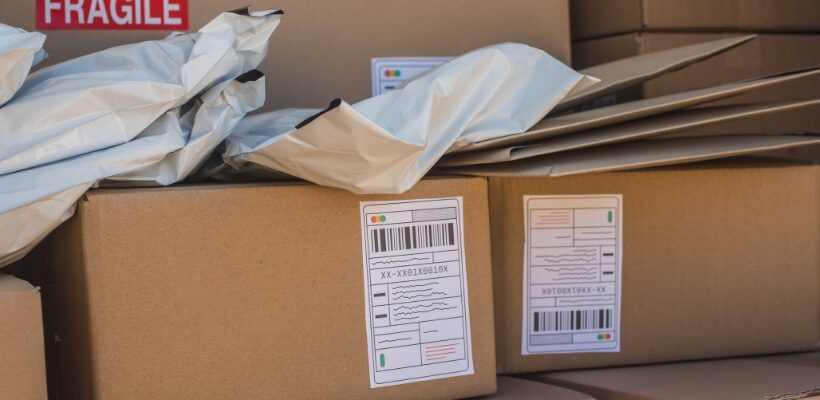
However, cardboard can be challenging to store in large quantities and may lose structural integrity unless it is specially treated when exposed to moisture.
Additionally, delicate products may require further internal packaging to ensure complete protection throughout shipping.
Pros:
- Strong and durable, ideal for protecting fragile or heavy items depending on the board grade.
- Easily recyclable and biodegradable.
- Available in various grades for different protection levels.
- Easily customisable for branding and product fit.
Cons:
- It can be bulky when stored in large quantities.
- It can weaken when exposed to moisture unless treated or coated.
- Additional testing may be required for exceptionally fragile items.
Mailing bags
Lightweight and water-resistant shipping
Mailing bags are particularly popular among eCommerce businesses for shipping non-fragile items such as clothing, jewellery, or other accessories.
These plastic self-sealing bags are lightweight and water-resistant, providing practical and space-saving solutions that keep products clean and dry. They are cost-effective and compact, making them ideal for businesses that ship in bulk.
However, traditional mailing bags are not environmentally friendly and can take hundreds of years to decompose. Sustainable alternatives to traditional mailing bags are becoming more readily available on the market, so these options are worth exploring to align with sustainability goals.
Mailing bags also provide minimal protection for products that are sharp, heavy, or breakable, making protective packaging a necessary investment.
Pros:
- Water-resistant, protecting against dirt and moisture.
- Lightweight and cost-effective for non-fragile items.
- Compact design saving space for bulk storage.
Cons:
- Typically non-recyclable unless specified as eco-friendly.
- Less protective for sharp, heavy or delicate items.
Padded envelopes
Compact protection for smaller products
Padded envelopes are typically lined with bubble wrap and are a reliable choice for shipping smaller, more fragile items like books, jewellery, electronics, and other items that wouldn’t be protected in a mailer bag.
Padded envelopes strike a balance between protection and convenience. They are lightweight and space-efficient, and they are available in various sizes and materials, allowing flexibility across different product types.
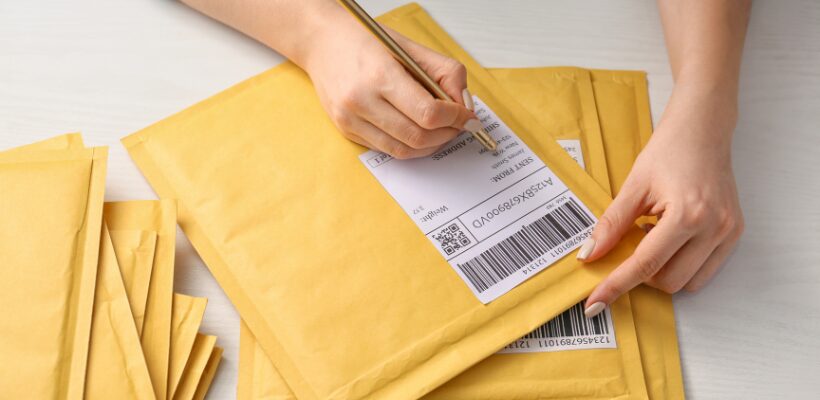
Their internal bubble wrap lining can complicate recycling efforts, and they may not offer sufficient protection for bulker or even sharper products.
While they are relatively durable, they can still be susceptible to punctures or tears if mishandled during shipping.
Pros:
- They are lightweight and cost-effective.
- The compact design saves space when stored in bulk.
- They come in various sizes and materials, giving you flexibility.
Cons:
- Limited protection for heavier, bulkier or sharper items.
- Plastic bubble wrap makes recycling complicated.
- Although durable, they remain vulnerable to punctures and tears during shipping.
Cardboard tubes
Secure shipping for documents or artwork
For shipping documents, posters, blueprints, or artwork, cardboard tubes are a go-to solution among postal packaging supplies.
These cylindrical containers provide excellent resistance to external pressure, helping to prevent the creasing or folding of sensitive materials.
Available in various sizes and diameters, they can be tailored to specific product dimensions and enhanced with tamper-resistant end caps for added security.
However, their shape makes them less efficient for stacking and storage than boxes or envelopes; their unusual dimensions may incur extra courier fees, and customising them with branded designs could be more complicated and costly than with flat surfaces.
Pros:
- They provide strong resistance to external pressure.
- They are available in various diameters and lengths and can be tailored to fit specific products, minimising wasted space.
- They can be made tamper-resistant with secure end caps to offer security that helps prevent tampering during shipping.
Cons:
- The cylindrical shape can make them less efficient for stacking and storing than boxes or envelopes.
- Due to their non-standard shape, they may incur additional shipping fees.
- Customising tubes with logos or branded designs may be more complex and costly than flat surfaces.
Bubble wrap
Flexible cushioning for fragile products
As one of the most commonly used protective materials in postal packaging supplies, bubble wrap provides exceptional cushioning for fragile products.
Its lightweight composition reduces shipping costs, and its flexibility allows it to be quickly wrapped around items of any shape or size.
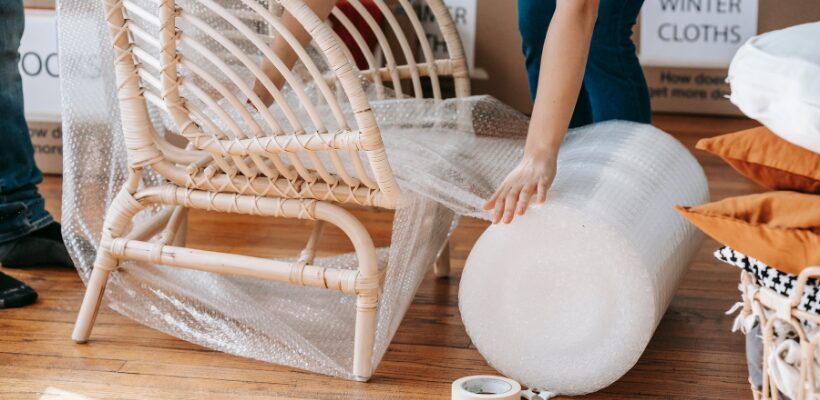
Despite these advantages, bubble wrap occupies considerable storage space and is often at odds with eco-friendly business practices unless biodegradable alternatives are chosen. For businesses that are prioritising sustainability, this can be a significant drawback.
Pros:
- Excellent cushioning for delicate and fragile items.
- Lightweight, minimising adding shipping costs.
- Flexible and easy to wrap around oddly shaped items.
Cons:
- It can occupy a significant amount of storage space in large quantities.
- It is not an environmentally friendly protective solution, although sustainable alternatives are available.
Paper void fill
The eco-friendly space filler
Paper void fill is an environmentally friendly material that prevents your products from shifting inside their packaging during transit.
Made from recyclable or biodegradable paper, it is lightweight, easy to use, and an excellent way to wrap delicate items or fill empty spaces.
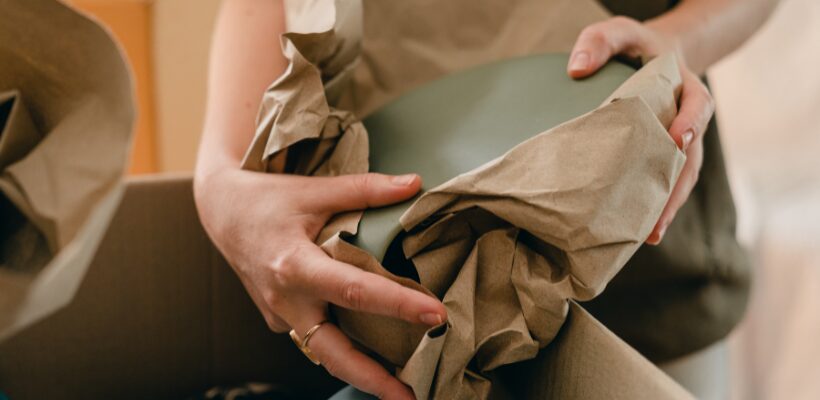
While it’s a sustainable choice that appeals to eco-conscious consumers, it may not offer the same level of shock absorption as bubble wrap or foam, and additional layers may be necessary to ensure adequate protection for your products.
Pros:
- Fully recyclable, biodegradable, and sustainable.
- Lightweight and cost-effective.
- It is ideal for wrapping delicate items or filling small packages with empty space.
Cons:
- It is less protective than bubble wrap or foam.
- Additional layers may be required for adequate cushioning.
Foam
Custom protection for high-value products
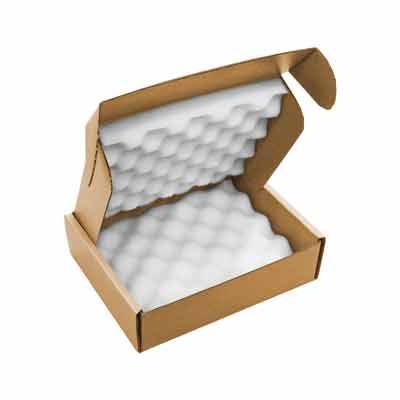
Foam packaging is excellent for high-value and fragile products like electronics or glassware. It provides top-tier cushioning and can be custom-moulded to the shape of specific products, ensuring minimal movement and maximum protection during shipping and handling.
It is also durable and, in some cases, reusable. However, foam is often non-recyclable and bulky when stored in large quantities, which can be an issue for businesses aiming to reduce waste and storage costs.
Pros:
- Offers excellent cushioning for fragile and high-value items.
- It can be custom-moulded to fit specific products.
- Durable and reusable in some cases.
Cons:
- It is bulkier and less space-efficient than other protective materials.
- Often, it is non-recyclable and environmentally unfriendly, although there are sustainable solutions available.
Tapes
Securing your postal packaging
No packaging is complete without tape, a fundamental component of postal packaging supplies. High-quality tape ensures your packaging remains sealed and secure, preventing tampering or accidental opening during transit.
Eco-friendly paper tapes offer a more sustainable alternative to traditional plastic tape, and reinforced options provide extra strength for heavy-duty parcels.
While traditional plastic tape is non-recyclable and contributes to environmental waste, paper tape may require special dispensers, which will be an initial cost to consider.
Pros:
- It proves a strong, tamper-proof seal.
- Available in eco-friendly paper tape alternatives.
- Reinforced options are available.
Cons:
- Traditional plastic tape is non-recyclable and contributes to waste.
- Paper tape may require special dispensers for efficient use.
Plastic wrap
Stablising bulk packages efficiently
Plastic wrap tightly binds and stabilises multiple items or pallet loads, offering protection from dust, dirt, and moisture. Its flexibility and ease of application make it a preferred choice for large-scale shipping operations.
However, plastic wrap is typically non-recyclable and can lead to excessive waste if not used mindfully. Its single-use nature clashes with efforts towards sustainable packaging practices.
Pros:
- Excellent for stabilising bulk shipments or heavy loads.
- It protects against dust and moisture.
- Easy to apply for securing pallets or grouped packages.
Cons:
- Typically non-recyclable plastic.
- It can be wasteful if overused.
Packing peanuts
Lightweight shock absorption
Packing peanuts is another protective void fill used to cushion products and prevent them from shifting too much during shipping. They provide good shock absorption and are very lightweight, keeping your shipping costs low.
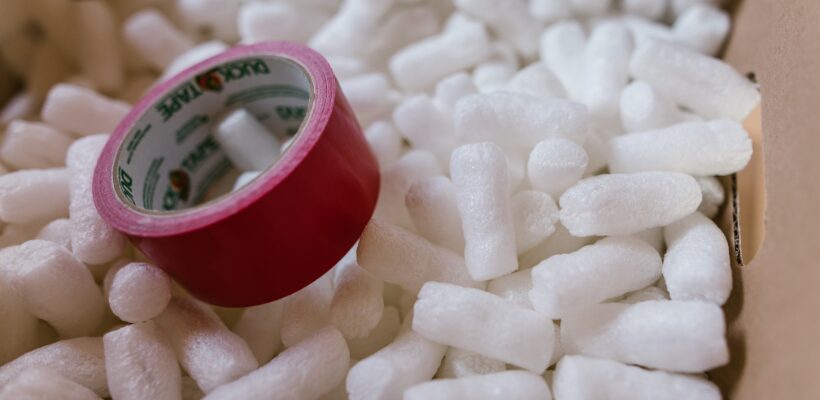
Traditional expanded polystyrene (EPS) packing peanuts pose a significant environmental concern, while biodegradable versions made from cornstarch offer an environmentally friendly alternative to conventional types of packing peanuts.
Nonetheless, they can be messy, and customers often find them inconvenient to dispose of.
Pros:
- Provides superior shock absorption by filling space in boxes.
- Lightweight and effective for reducing item movement during transit.
- Biodegradable options are available and widely available.
Cons:
- They can be messy and inconvenient for customers to dispose of.
- Traditional expanded polystyrene versions are non-recyclable and harmful to the environment.
Summary
Getting the right balance with postal packaging supplies
Selecting the right postal packaging supplies requires a careful balance of protection, cost, environmental impact, and customer experience.
From sturdy boxes to flexible mailing bags and sustainable void fills, each material has its own strengths and limitations. By understanding these pros and cons, you can tailor your postal packaging strategy to suit your products and brand values while ensuring the safe delivery of your products.
With the growing demand for sustainable practices, there is a clear shift toward sustainable postal packaging, which is increasingly influencing consumer purchasing decisions and behaviours.
If you require assistance selecting the right postal packaging supplies for your business, please contact us at GWP Packaging today.
Share this article
Further reading


About the author

David joined GWP Packaging in 1995. His extensive knowledge and experience of corrugated packaging means he is widely regarded as an expert on this topic.
Products in this guide



Get in touch
For full details on how GWP treats your data, please view this Privacy Policy. Your info is not shared with any third party.
Related guides
Unboxing trends and how consumers view eCommerce packaging
Sustainable postal packaging – 6 options for your business
What is the packaging extended producer responsibility (EPR)?
11 branding ideas for printed eCommerce boxes and packaging
A beginners guide to the Plastic Packaging Tax
Recycling symbols on packaging (+ free downloads)
Corrugated board grades explained: types of cardboard
5 key considerations for postal packaging success