









Introduction
Finding the right packaging for your manufacturing business
Whether you manufacture automotive components, medical equipment, electronics, or heavy industrial products, packaging plays a key role in safely moving your goods from your facility to their next destination.
However, choosing the right manufacturing packaging involves more than finding a box that fits. You need to consider how your products will be stored, handled, protected, and transported, along with the costs and practical requirements of your operation.
Unsuitable packaging can lead to damaged products, wasted materials, slower packing processes, or unnecessary storage requirements.
On the other hand, a well-designed solution can help protect your products, make handling easier and support a more consistent approach to packing and dispatch. This is particularly important if you manufacture products in different sizes, weights or configurations, each with its own packaging requirements.
In this guide, we’ll explain the main types of manufacturing packaging, how to choose the right materials and designs, and what to consider when reviewing your costs, efficiency, and sustainability.
Contents
- What is manufacturing packaging?
- What types of packaging do manufacturers use?
- How do you choose the right packaging?
- How can packaging improve manufacturing efficiency?
- How can you balance costs with protection?
- Single-use vs returnable packaging
- How can manufacturers make packaging more sustainable?
- What regulations should you consider?
- How can you prepare for year-end?
- Summary
What is manufacturing packaging?
Understanding the role of packaging in the production process
Manufacturing packaging refers to packaging used to contain, protect, store, handle, and transport products from a business to a customer.
It covers everything from Correx® trays that hold individual components to heavy-duty timber crates that are designed to hold large machinery. Requirements vary depending on the products you manufacture, your production processes, and how goods move through your supply chain.
Packaging can be used at multiple stages in the manufacturing process; for example, containers and trays keep components organised and protected during production.
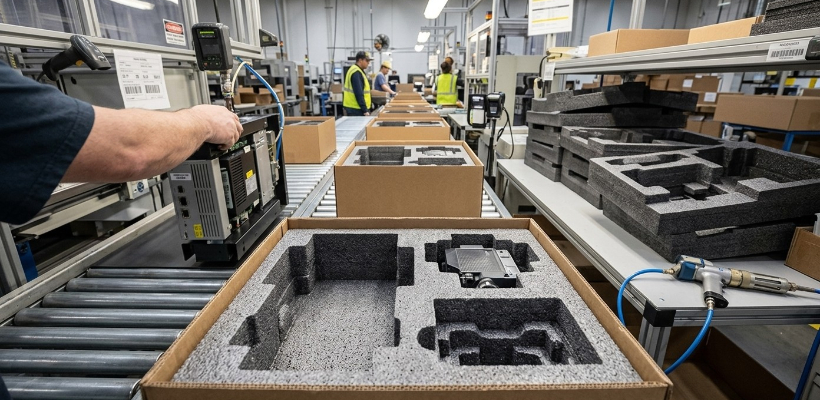
Once products are ready for dispatch, corrugated boxes, protective foam inserts, and outer cases help prepare them for storage and transport. Some businesses will also require packaging that can be returned and reused as products or components move between factories, suppliers and customers.
This means you should consider packaging as part of your wider operation; for example, a packaging format that provides excellent protection during delivery might take too long to assemble on a busy production line. Similarly, a compact box might save storage space but provide insufficient room for the internal protection a fragile product needs.
What types of packaging do manufacturers use?
Exploring packaging formats for different applications
The packaging that manufacturers use depends on the product type, its dimensions, and the level of protection required.
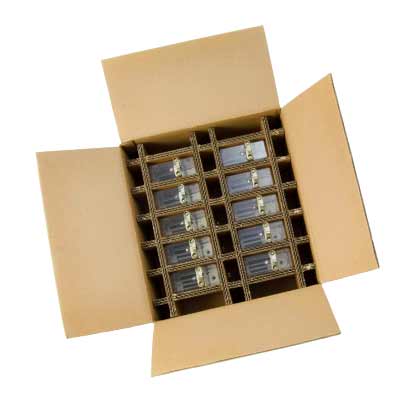
Corrugated cardboard boxes are a common choice for finished goods and components because they come in different sizes and strengths. Custom corrugated packaging can be designed around a specific product, while heavy-duty corrugated cases suit larger, heavier items that need more structural support.
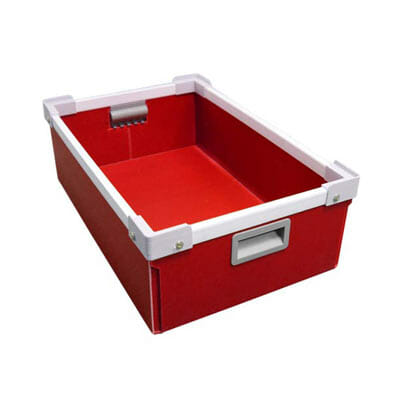
Manufacturers may use plywood cases, timber crates, or other specialist containers when products require even more structural support. Euro containers, Correx® trays, and Correx® picking bins are also all useful solutions to use in a manufacturing environment, particularly where components need to be organised and moved between workstations.
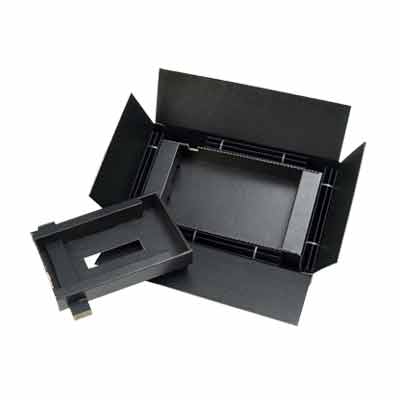
Internal packaging is equally as important; your foam inserts, corrugated inserts, vacuum-formed trays and textile dividers can separate products and prevent them from knocking against each other. The right option depends on your requirements, whether you need to absorb impacts, maintain a product’s position, protect surfaces, or keep multiple components organised.
Often, the most effective solution combines the outer package with internal fittings designed for the specific application.
How do you choose the right packaging?
Match your packaging to products, processes and journey
Start by assessing the product itself; consider its size, weight, shape, fragility and any features that could be damaged if it’s knocked, compressed or allowed to move.
Next, think about how the product will move through your supply chain. Will it be carried by hand, moved using a pallet truck or lifted by forklift? Will it be stored for several weeks, stacked with other products or transferred between different production areas? These details affect your packaging dimensions, strength, ease of handling, and whether you need any additional support. If your goods will be transported over long distances or handled several times, you should also consider the risks associated with vibration, impact and changes in environmental conditions.

Finally, consider the requirements of the customer receiving these goods. Some products may need to arrive ready for use, while others go to another manufacturing facility for further processing. Packaging that is easy to open, unpack and dispose of can make life easier for the recipient.
Before committing to a new design, make sure it has been tested with the actual product and the people who will use it. Check that the item fits correctly, the packaging is easy to open, and it provides the necessary protection for your products. Testing at this stage helps you identify issues before rolling out a new solution across your operation.
How can packaging improve manufacturing efficiency?
Reduce unnecessary handling and operational complexity
The time your employees spend assembling boxes, fitting inserts, securing goods, and preparing shipments can affect the efficiency of your production and dispatch processes.
One way to improve efficiency is to design packaging around the product and how your employees handle it. When you pack the same products repeatedly, you can make easy improvements; for example, custom boxes can reduce the need to modify standard packaging, while fitted inserts and dividers can make it easier to position components correctly. Dedicated trays and containers can also help your employees identify, count, and move parts without sorting through mixed items.
It’s also worth reviewing how many packaging formats you use, as maintaining too many box sizes, inserts, or container types can complicate purchasing and stock management.
Where practical, standardising suitable formats can simplify ordering, storage and staff training. However, standardisation should not mean using one package for products with significantly different protection requirements. The aim is to remove any unnecessary variation without compromising performance.
Measure the results of any changes you make, and compare packing times, packaging consumption, stock levels, and damage rates before and after introducing a new design. This gives you a clearer picture of whether the packaging is improving your operation and helps identify further opportunities to make processes more efficient.
How can you balance costs with protection?
Look beyond the price of the packaging
When reviewing your manufacturing packaging, it can be tempting to focus on the cost per unit; however, the cheapest option at the point of purchase might not deliver the best overall value.
Consider the overall cost of using the packaging throughout your operation, including the packaging itself, the time required to assemble and pack, the space required to store it and any additional materials used to secure the product.
You should also take into account the potential cost of damage, including replacing goods, arranging repeat deliveries and resolving any customer complaints. The relative importance of these costs will depend on your products and business processes.

Another expensive consideration is overspecification: if your packaging is significantly stronger or larger than the product requires, you’ll use more material than necessary. Review the design, board grade, dimensions and internal fittings to identify opportunities to reduce excess material while maintaining the required level of protection.
A packaging review can help you identify whether making changes are worthwhile; for example, a custom design might reduce packing time or replace several separate components, while a more suitable internal insert could reduce product movement. Compare alternative designs against the same requirements and assess their performance before making a decision. This lets you balance purchase price, operational efficiency, and product protection rather than treating them as separate concerns.
Single-use vs returnable packaging
Compare single-use with reusable solutions
Single-use packaging, like corrugated boxes are designed primarily as a single-use option, making them a practical option for one-way supply chains.
Whereas returnable packaging, like plastic containers, trays or totes are designed to be used repeatedly in regular movements between manufacturing sites, suppliers and customers.
The best choice depends on how often the packaging will be used, how far it will travel, and whether a reliable return route exists. If your products are regularly transferred between the same locations, it might be worth comparing the cost and practical requirements of a reusable system with those of single-use packaging. If you ship to a wide range of customers, a one-way solution may be simpler.
Assess the full journey rather than assuming that one option is always better.
How can manufacturers make packaging more sustainable?
Reduce unnecessary material and consider end-of-life
Sustainability is an increasingly important consideration when you are reviewing your packaging, but the right approach depends on your products and supply chain. Reducing any unnecessary material, selecting packaging that can be recycled through suitable collection systems and using returnable solutions where practical support waste reduction. However, any changes must still provide the level of protection your products require.
Start by reviewing your existing packaging for any unnecessary space, layers or components. An oversized pack may require more material and extra void fill, while a product-specific design can reduce both. The goal is to use the right amount of packaging, not simply less regardless of the consequences.
Recycling is another consideration: the UK government’s latest waste statistics show that 80.3% of paper and cardboard packaging waste was recycled in the UK in 2025, but that does not guarantee every individual pack will be recycled. The outcome depends on factors like the packaging’s construction, contamination and the waste collection arrangements available to the business or the end user.
It may also be worth considering reusable packaging solutions for some applications where products travel along regular routes, and containers can be returned efficiently.
What regulations should you consider?
Understand your responsibilities
UK packaging regulations can affect businesses that supply, import, or place packaged goods on the market.
One particularly important area is Extended Producer Responsibility (EPR) for packaging. Depending on the activities and reporting thresholds that apply, businesses may need to register, report packaging data, and meet relevant recycling or waste disposal fee obligations. Not every manufacturer has the same responsibilities, so it’s important to assess your own position.
EPR can make packaging data and material choices more relevant to your purchasing and design decisions. Businesses within scope need accurate information about the packaging they supply or import, including its material and weight. Keeping suitable records and understanding which business in the supply chain is responsible for reporting can help support compliance.

If your business supplies products to customers in Europe, you should also check whether the EU Packaging and Packaging Waste Regulation (PPWR) applies to your activities.
Regulatory requirements can change, and the rules that apply will depend on your business, products and markets. If you are reviewing packaging to reduce waste, improve recyclability or prepare for new requirements, check the latest official guidance and seek specialist advice where needed.
How can you prepare your year-end?
Review demand, availability and performance
The final months of the year create additional challenges for manufacturing and distribution business operations. Order patterns may change, customer deadlines may tighten, and public holidays may affect production and delivery availability.
Start by reviewing forecasted production volumes, planned dispatches and any known customer shutdowns. Identify frequently used packaging formats that take longer to source or require bespoke manufacture. Checking stock levels and lead times early can help you avoid last-minute shortages and give you more time to address any packaging performance or suitability issues.
Avoid making any changes that aren’t tested just to meet a deadline, as they can introduce a whole new set of problems. Planning ahead gives you time to review specifications, test samples, and coordinate packaging supply with your production schedule.
These checks can help at any time of year, but they’re especially valuable when you have less flexibility to resolve problems at short notice.
Summary
Find a solution that supports your products and operation
Choosing the right manufacturing packaging starts with understanding what you make, how you handle your products, and what they need throughout the supply chain. Corrugated boxes, heavy-duty cases, timber crates, plastic containers and bespoke internal protection all have different applications.
The most suitable option depends on your product, the required level of protection, and the practical demands of your operations.
It’s also important to consider the wider impact here too as the right design can support more efficient packing, simplify your stock management and help control your overall costs. Comparing single-use and returnable options, reducing any unnecessary material use and understanding any relevant packaging regulations will help you make better-informed decisions.
Finally, review your requirements regularly, especially before busy year-end periods, to identify issues early and maintain a reliable supply of suitable packaging.
If your current packaging no longer meets your manufacturing needs, our team of packaging experts at GWP can help you review your requirements and explore suitable options. With experience across a wide range of packaging types and applications, our team can help you assess product protection, packaging design and opportunities to improve efficiency.
About the author

David joined GWP Packaging in 1995. His extensive knowledge and experience of corrugated packaging means he is widely regarded as an expert on this topic.
Important note
Due to the sensitive and regulated nature of the topic this guide addresses (eco-friendly packaging) we have taken extra steps to ensure its accuracy and reliability. You can find out more in our content policy.
All information is, to the best of our knowledge, accurate and correct at the time of publication. Please also note that, as all scenarios vary, not all information contained in this guide may apply to your specific application. There may also be specific regulations or laws, not covered within this particular guide, that apply. Please view the list of sustainable packaging regulations for further details.
Share this article
Further reading

Featured products



Get in touch
For full details on how GWP treats your data, please view this Privacy Policy. Your info is not shared with any third party.
Related guides
Manufacturing productivity (11 tips to improve your performance)
Choosing the right packaging inserts: Correx, foam, and vacuum-formed trays
Heavy-duty cardboard boxes: What are your options?
Pallet packaging – 7 advantages of well-optimised boxes
5 dunnage options and returnable packaging inserts
5 ways to reduce storage needed for your packaging
What is the packaging Extended Producer Responsibility (EPR)?
Extended Producer Responsibility (EPR) fees explained
EPR reporting – what packaging data does the new scheme require?
Packaging Waste Regulations quick guide (2026 update)
A beginners guide to the Plastic Packaging Tax
Recycling symbols on packaging – explanation and free icon downloads
Recycling Assessment Methodology: What it means for your business