









More than just a box
When it comes to online shopping, the packaging is more than just a cardboard box
In the last month, you have likely come into contact with some form of eCommerce packaging.
You have likely received an order from an online shop within the last week. Chances are, you may even have received a delivery the same day that you read this – and you’re not alone.
Worldwide eCommerce sales are estimated to increase by 9.2% in 2025. In the US, the largest eCommerce market, 56% say that they prefer to shop online, with 85.6% having made an online purchase in the last 30 days.

Online sales in August 2025 accounted for 26.1% of all retail sales in the UK. Although this represents a decrease from the peak of 37.8% during the pandemic in 2021, when consumer behaviour changed drastically, it has still been a steady increase from pre-COVID times.
With around 90% of products being shipped using corrugated boxes, a significant amount of packaging is sent via postal and courier services.
Contents
- The crucial role of packaging
- Seven facts on packaging importance
- First impressions count
- Packaging is almost equal to branding
- Increase in interest and retention
- Nearly all orders are sent in cardboard
- Generate extra spend if shipping is free
- Slow shipping discourages customers
- Custom packaging drives loyalty
- Summary
The crucial role of packaging
The essential part that packaging plays in eCommerce
Everyone has a good laugh when there is another newspaper story about how Amazon (or another large online retailer) has sent a tiny product in a comically oversized box.
Plus, most people have some experience of a package arriving looking battered and bruised. Or even worse, when damage to the product itself occurs during transit.
Whilst these examples are amusing and annoying in equal measure, for the vast majority of the time, online orders are delivered successfully with little fuss. For many, though, the excitement (or lack thereof) in receiving their items means the packaging is largely overlooked.
However, this behaviour can lead to eCommerce sellers overlooking a potential opportunity.
The importance of eCommerce packaging
eCommerce packaging is of significant importance to the success of a business. Often being the first physical interaction a consumer has with a brand, 52% of consumers indicate that they would be more likely to purchase from the same company again if the packaging exceeds their expectations. According to research, 73% of UK consumers rely on packaging to shape their buying decisions.
Successful, well-thought-out eCommerce packaging can significantly impact your business’s success. It can help to minimise the volume (and cost) of returns. It can help to foster customer loyalty. It can get your branding in front of more people.

It may even result in your packaging receiving thousands of views on YouTube in an “unboxing video”.
So, while packaging needs to fulfil its primary task of getting your products to your customers safely and as cost-effectively as possible, there are several additional benefits your business can leverage if you know how.
Seven eCommerce packaging facts
Seven eye-opening statistics on the importance of eCommerce packaging
The importance of eCommerce is highlighted quite starkly in several facts and figures gleaned from numerous studies and research conducted over the last few years.
With the explosion in eCommerce, particularly through the lockdowns of 2020 and 2021, more attention has been paid to packaging by savvy online businesses. This focus has resulted in the following findings.
- Consumers generally form their first impression of a brand (and indeed many other things) within 1/10th of a second. It is very difficult to change after that.
- Research has shown that around 63% of consumers consider a product’s packaging almost as crucial as the brand itself.
- On average, online sellers and businesses that prioritise their packaging report a 30% increase in consumer interest.
- Approximately 90% of products are shipped in cardboard packaging.
- Slow shipping times (which can be influenced by packing processes that are too slow) deter consumers, and 23% of shoppers state that they would not buy from the same store again after a delayed delivery.
- Conversely, if you can absorb the cost of shipping and packaging to offer free delivery, it is likely to result in a 30% higher average order value for customers.
- Around 52% of online shoppers who receive their order in custom packaging say they are more likely to return to that same company for future orders.
So, what does this mean for your eCommerce packaging? Please continue reading to learn how you can utilise your postal boxes to your advantage.
First impressions count
Ensuring customer satisfaction from the start
As highlighted earlier, people generally form a first impression of something or someone within 1/10th of a second.
The same thing happens with the eCommerce orders you ship to your customers.
The individual has looked at your online shop, conducted research and decided to place an order with you, but what is the first physical interaction that they have with your business?
Your packaging.

If a shabby, damaged box turns up, it creates a terrible first impression, and whilst online sellers must avoid this at all costs, it is possible to focus on much more than just ensuring the parcel reaches your customer in one piece.
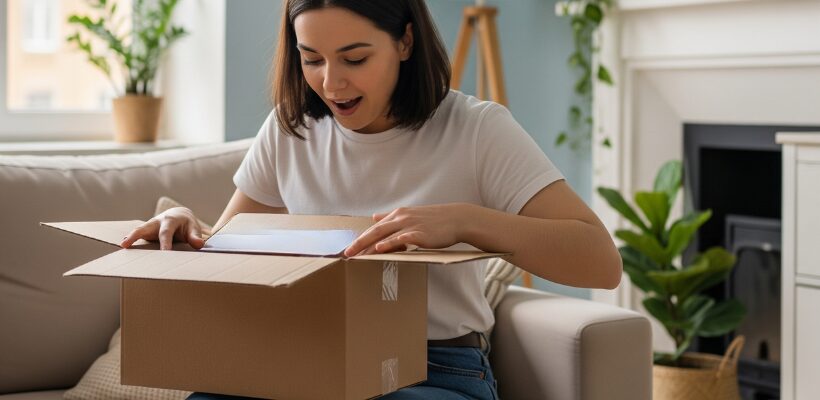
Clever branding, personalisation and more can make your customers feel valued and add to the sense of excitement. A focus on the customer experience provided by packaging is why there has been an enormous growth in unboxing videos on platforms such as YouTube.
Ultimately, think about how you would feel handing over a damaged, shoddy-looking box to a customer in person, someone who has potentially just spent hundreds of pounds with your business. Make sure that doesn’t happen.
Packaging is almost equal to branding
Brand values, proposition and position in the market
Studies have shown that nearly as many people think the packaging itself is as important as the brand they purchase from.
However, there is an argument that this is a bit ingenious.
Your eCommerce packaging should be an extension of your brand. It should be a vital part of conveying what your business and products are about (and how they can make your customers feel).
Take Apple as a good example, their products, from AirPods to their high-end MacBooks, are luxury, high-end products. If you’ve ever purchased one of their products, you know that the packaging is of equal quality: sturdy, aesthetically pleasing and tactile.
In effect, it aligns with their brand values, proposition, and position within the market.
Increase in interest and retention
Enhancing customer lifetime value
Considering the previous facts, it should come as no surprise that online businesses that invest time in their packaging see up to a 30% higher interest from customers.
This improvement in customer engagement could be attributed to a variety of reasons.
Perhaps they have built a good reputation by consistently delivering high-quality goods. Perhaps the brand value that attracts customers to purchase in the first place is reflected in the packaging. It may even add to the excitement of receiving an order, aiding loyalty and generating repeat business.
Even beyond that, successful packaging (particularly with the “wow factor”) is likely to benefit your business through the oldest and arguably most effective form of marketing: word of mouth.
Customers who receive visually appealing packaging are more likely to recommend it to their friends and family. In fact, 40% of customers share photos of product packaging on social media if they find it unique or branded. Some customers may even retain the pack (with your branding on) for much longer or indefinitely.
Cardboard shipping
The use of cardboard boxes to ship orders is widespread
The view of cardboard boxes is that they are one of the most mundane and basic products used by individuals daily (try starting a conversation at the gym or pub about them to see precisely how uninteresting they are!)
This perception represents both a challenge and an opportunity.
Suppose your competitors are simply using standard, brown, unbranded boxes with no striking features whatsoever. In that case, you immediately have a point of difference from them and can use this position yourself where you finish in the market (e.g., the luxury, premium option, perhaps, or maybe the eco-friendly choice).
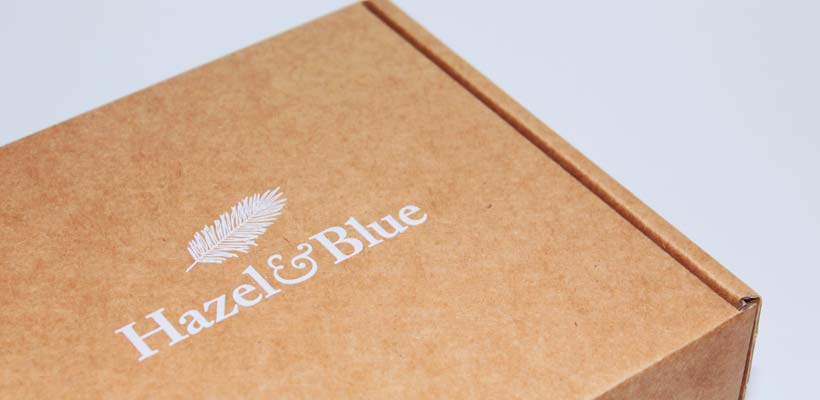
The opportunity provided by your packaging allows you to start developing your brand and add some real value to your products.
It may even be worth placing some orders with your competitors to see what they are doing, so that you can improve on it.
Make sure your business isn’t the one that blends into the crowd or is eclipsed by your nearest rivals.
Order values
See an extra 30% spend if shipping is free
Therefore, a significant portion of this comes down to your courier or shipping partners; however, your packaging still incurs costs.
Even if you are only paying 20, 30, or even 50 pence per box, over the course of a thousand orders, this can add up to a significant cost.
Moreover, the size of your box can also significantly impact your shipping costs, particularly with the introduction of volumetric (i.e., by size) and pricing in proportion charges.
It is therefore critical that you have appropriately sized boxes for your order (or you are paying to ship air or void fill, such as foam and air sacks), and that is balanced with a sensible unit price for your packaging.
It may be tempting to pass the cost of shipping to your customers, but statistics say it could seriously hamper your growth potential.

Slow shipping
Slow shipping time discourages customers
Again, while a reliable courier makes a significant difference here, many people overlook the fact that picking and packing an order also takes time.
Whilst you should have a robust plan and process for picking eCommerce orders, businesses frequently neglect or forget the actual packing part.
Boxes that are slow or difficult to assemble and/or seal can add critical time to the fulfilment process, as can the retrieval of boxes if you have an extensive and complicated inventory.
If you know you can get an order picked and packed as quickly and efficiently as possible, with your packaging helping, it gives you a fighting chance of offering following or even same-day delivery options.

Customer loyalty
Custom packaging drives customer loyalty
Over half of the people who have received custom packaging say that they would use the same company for future orders.
That is a significantly strong argument for at least considering custom eCommerce packaging.
Even moving beyond those statistics, custom packaging tends to be cheaper to send (as a custom-sized package reduces the volume and shipping charges). Bespoke eCommerce packaging typically provides better protection for the contents by minimising movement during transit. It is also better for the environment by using less material and eliminating secondary packaging (and the cost), such as foam pellets or polystyrene.
Custom eCommerce packaging also gives you that chance to drive customer loyalty, increase your brand’s visibility and generally delight your customers.

Summary
The importance of your eCommerce packaging
Whilst often overlooked, especially as a marketing tactic, your eCommerce packaging has the potential to increase your sales, drive customer loyalty, and position your business where you want to be in the market.
All of this, in turn, has a significant impact on your business’s success and profitability.
So, in summary, overlook your eCommerce packaging at your peril!
Share this article
Further reading

About the author

Jay joined GWP Packaging in 2008, before going on to hold senior positions at VPK and Cotswold Packaging. He maintains close ties with GWP and Macfarlane.
Featured products




Get in touch
For full details on how GWP treats your data, please view this Privacy Policy. Your info is not shared with any third party.
Related guides
Printed eCommerce boxes – unique branding ideas
eCommerce statistics: 200+ online shopping and packaging facts
Printed cardboard packaging – your options
Analysis: Stock vs custom eCommerce packaging
eCommerce shipping – the crucial role played by packaging
Corrugated board grades explained: types of cardboard
eCommerce unboxing experience: ideas and best practice